



The fuss over oil prices is once again huge. If you dare to call for calm (which I have done), a shitstorm is inevitable. In a world where many still claim we are rapidly heading towards a transformation that will lead to the complete abandonment of fossil fuels, there is hardly anything that drives people (or rather, those who claim to be the mouthpiece of ‘the people’) more into a rage than high fuel prices.
If one even suggests that the real price of oil is no higher than it was a few decades ago, many are completely beside themselves and immediately lose their minds. Yet it is obvious: if I want to know how much of a burden rising petrol and diesel prices are, I must relate the price of fuel to what I am currently earning. It follows that one must at least look at a so-called real price to assess today’s burden compared to the past (the real price is calculated by subtracting the inflation rate from the current oil price each year). The following chart was produced by the US administration.
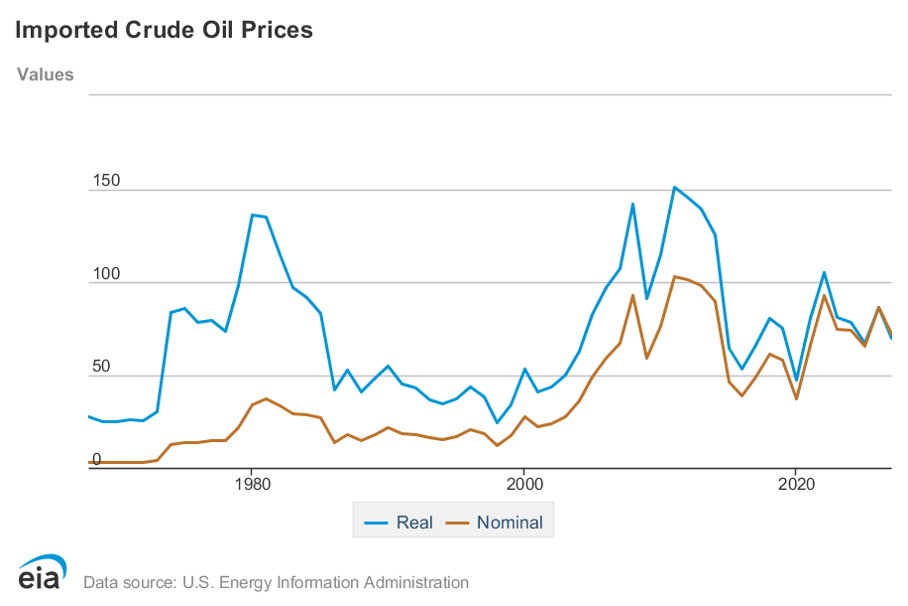
The result – the so-called real price – was significantly lower even in 2022 (a year that is quite comparable to current levels) than, for example, at the start of the 1980s. However, this method of adjusting for inflation is actually insufficient. Mass incomes do not merely rise in line with the inflation rate, but usually somewhat faster, because the rate of productivity growth is also factored in.
In the Atlas of the World Economy for the years 2022 and 2023, we calculated how many minutes one had to work in the past to buy a litre of petrol. This is the calculation to make if you want to be taken seriously.
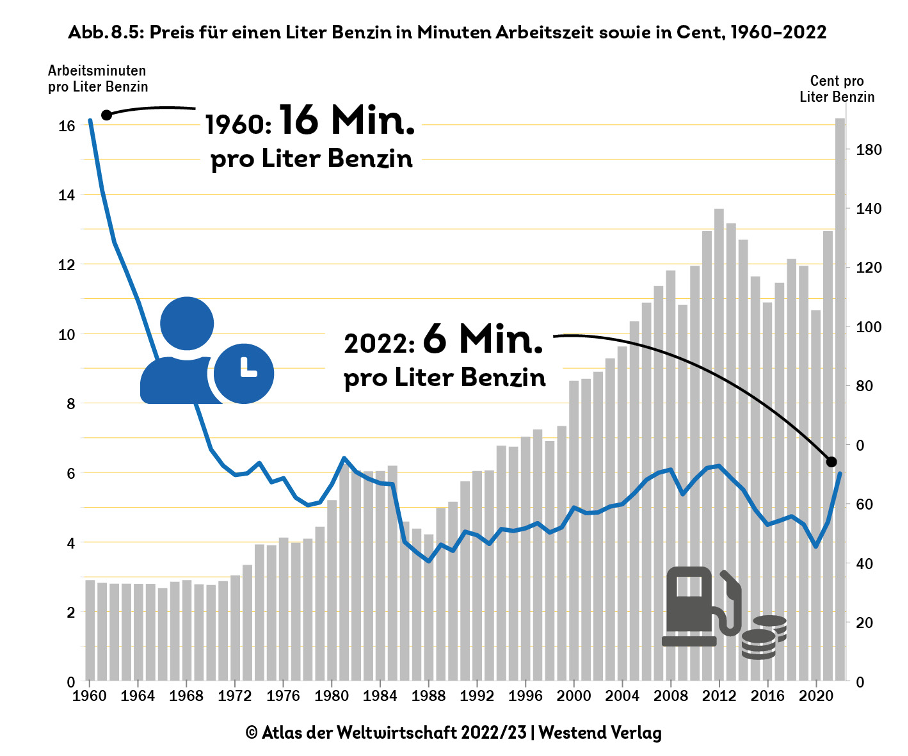
The result is clear: although the price per litre was still nearly 2 euros in 2022, this real cost was no higher than in 2012, 2008 or 1982. However, it was much lower than in the 1960s, when, in absolute terms, less than 40 eurocents was paid for a litre of petrol.
When you have this picture in mind, the fuss is put into perspective quite considerably. There is also much to suggest that there will be no prolonged surge in oil prices this time. The most important reason: Trump and his Republicans simply cannot afford high oil prices, because high oil prices will cause them to lose the mid-term elections in early November by a landslide. If the Democrats win majorities in both chambers of the House of Representatives, Trump will be a lame duck and will no longer be able to push through anything of significance. They could probably also forget about the re-election of a Republican two years later.
However, the current commotion also shows that any attempt by a government, or even the international community, to raise the real price of oil in the long term in order to achieve a phase-out of fossil fuels is illusory as long as economic conditions do not improve for the majority of the population.
Only those who are exceptionally successful economically can afford to push through such a politically engineered burden. Which means nothing other than that only with successful economic policy is there a chance of implementing climate or environmental policy. Anyone who wants to save the world should sit down and get to grips with relevant economics as a matter of urgency.