



Astute writers such as Michael Sauga of *Der Spiegel* realise immediately when things get serious: Europe needs austerity now. If Europe does not implement an austerity programme straight away, it is doomed. Europe must cut spending come what may. The best option would be an austerity programme in the style of Schröder’s Agenda. Der Spiegel calls this ‘politics without money’. In reality, however, it amounts to cheating one’s neighbours; it is known as mercantilism.
The Der Spiegel writer is, however, merely the messenger. He knows all this so well because he has read the International Monetary Fund’s latest recommendations for Europe. In a 70-page study, the Washington-based organisation has laid out for the Europeans exactly how to consolidate intelligently.
Unfortunately, the theory behind the study is so abysmally poor that one wonders how it is possible for an institution, which is funded generously by its member states and can hire the world’s best economists, to be capable of producing such rubbish.
The approach taken in such studies is always the same: to ‘prove’ that fiscal consolidation is possible without damaging the economy, one gathers as many examples as possible from as many countries as possible that show it has actually happened – namely, that an economy has grown despite consolidation. From this, they then conclude that it can be done again at any time, provided the political will exists. This approach requires no thought and no theory. If one can find a number of countries that have fared reasonably well economically despite austerity, the ‘proof’ is established.
For such an approach to be successful, it would require incredible meticulousness in describing the conditions necessary for such periods. After all, no one has ever disputed that the state can reduce its deficit if there are sufficient expansionary counterforces elsewhere. The best example is Germany at the start of the century, where – as I have explained hundreds of times – debt was shifted abroad through real devaluation within the monetary union. The US, too, experienced a brief phase of consolidation in the late 1990s, but this only succeeded because private households temporarily reduced their savings rate to below zero. That has never happened since, and consequently, no lessons have been learnt from it.
What do such cases prove? Absolutely nothing! The first proves that mercantilism can work if trading partners put up with it. The second proves that private households can, on one occasion – as happened back then – allow themselves to be swayed by a stock market boom. What can be learnt from this? Absolutely nothing! Can it simply be repeated? Under no circumstances!
England and France: No solution in sight
Let us take a closer look at the two countries currently at the centre of attention. France and England have exactly the same problem and are completely incapable of solving it if they rely on mainstream economic thinking.
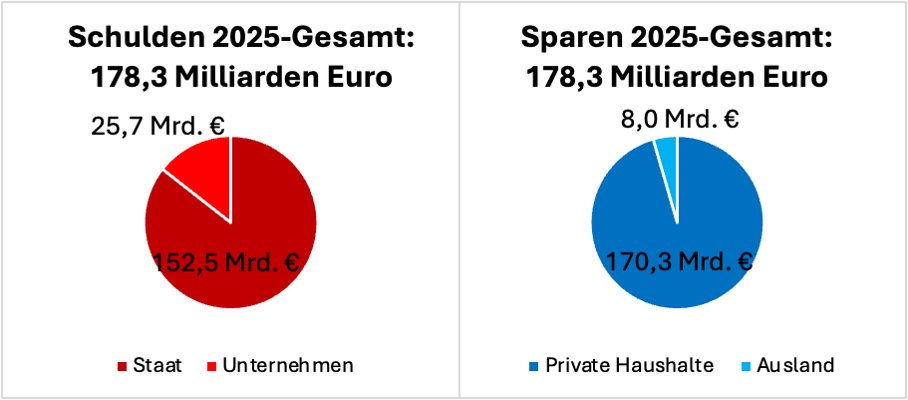
Figure 1 shows the fiscal balances for the year 2025 in France. Savings (Sparen) amount to almost 180 billion euros. The current account deficit (Ashland) was small in 2025, meaning that the bulk of the savings (170 billion) is attributable to private households. Looking at the corresponding items on the debt side (Schulden), it is striking that companies (Unternehmen) in France actually recorded a small deficit last year, meaning they went into debt on balance.
Nevertheless, by far the largest share is attributable to the government, at over 150 billion.
Figure 1: France
Source: INSEE
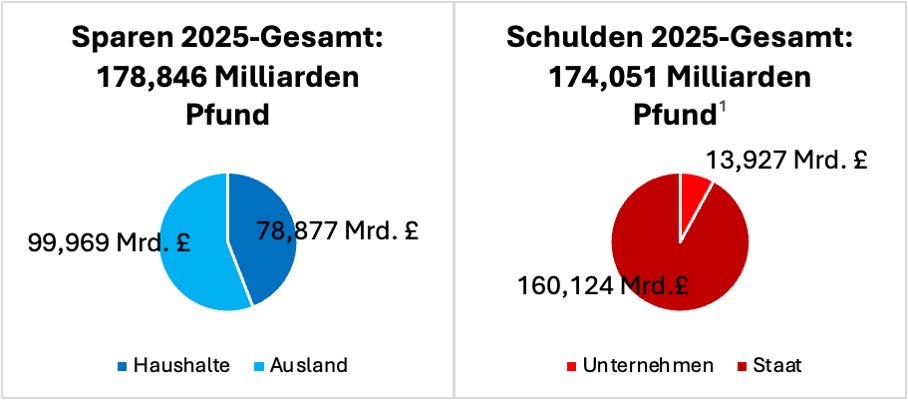
The situation is not much different in England. Savings – calculated in pounds – are almost as high as in France, although the current account deficit is much larger at nearly 100 billion pounds. Of the UK’s total debt, only 14 billion of the 174 billion pounds is attributable to businesses. The government must shoulder 160 billion (in England, there is a small statistical discrepancy of 4 billion pounds between savings and debts).
Figure 2: United Kingdom
Source: Office for National Statistics
The conclusion is quite simple, but evidently beyond the intellectual grasp of the IMF’s economists. One must ask whether it will be possible in the coming years to either turn the current account balances in both countries from a deficit to a surplus, or whether there are measures that promise to make businesses debtors to a far greater extent than in the past 20 years. Only then could the state withdraw without difficulty.
The answer to both questions must be a clear ‘no’. To bring about a turnaround in the current account balance, both countries would have to devalue in real terms, i.e. (for England) weaken their own currency or (for France) reduce wages within the monetary union. However, enforcing a devaluation of one’s own currency through state intervention is no easy task in a world where the US is trying by force to reduce its own massive current account deficit. For France, there is the added factor that wage cuts would severely damage the most important component of demand – domestic consumption – which a devaluation could by no means offset quickly, nor ever fully.
The state lacks the means to push companies back onto the debtor side to a much greater extent. Cutting interest rates – which would be the most obvious measure – has not proved particularly effective in the past (in the 2010s). In fact, no country in the world has managed over the past thirty years to make companies the main debtors once again. How could this be achieved in France or the UK in the coming years?
The IMF is simply acting like a Swabian housewife, without stating what the consequences of an austerity policy would be in such a case. That is irresponsible. They hide behind a ‘study’ devoid of any theoretical basis and conclude that things can work out, without asking whether the conditions in the major European countries are similar to those in the (in some cases very small) countries where it once worked out. The only thing the IMF has to offer is the claim that reducing public deficits would lead to a fall in current account deficits. Yet this is also completely off the mark in theoretical terms, as shown here.
France and the UK have no chance of reducing their government budget deficits. If they try, they will ruin economic development and public finances will have to run up even larger deficits. Consequently, they should not even attempt it, as it is certain to cause great damage.
The IMF is ignoring the US – and knows why
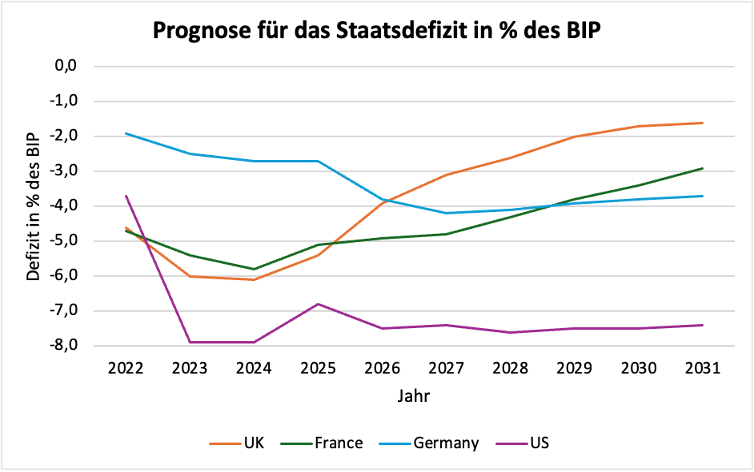
What’s more – and this is truly embarrassing for a globally active institution – it fails to recognise (or refuses to recognise) that Europe (the monetary union) is, in much the same way as the US, a large, relatively closed economy and must therefore act accordingly. In another publication from this spring, the IMF has updated its projections for how current government deficits are expected to develop in the key countries. The figures reproduced in Figure 3 can be found there. For every year from 2025 to 2031, the IMF expects France and the UK to reduce their deficits. In Germany, they will remain roughly the same at four per cent from 2025 onwards.
Figure 3 IMF forecast
Source: IMF Fiscal Monitor, April 2026
What is remarkable, however, is the IMF’s assumption regarding the US in this publication. It projects a deficit of 7½ per cent of GDP for every year, apparently without batting an eyelid and in the full knowledge that there is no other option. The result is an increase in the US debt-to-GDP ratio (total government debt relative to nominal GDP) from the current 125 per cent to 142 per cent in 2031. For the EMU, by contrast, the ratio is expected to rise by just one percentage point, from 88 to 89 per cent.
For Europe, the IMF is putting on an unbelievable circus over interest rate rises, the financial crisis and so on. For the US, there is nothing of the sort. The IMF knows full well what it would have to expect from the US administration if it were to go public with horror scenarios for the US similar to those for Europe. Only the silly Europeans – they can be scared with wild horror stories that lack any reasonable basis.
Thanks to Erik Münster for his help with the empirical analysis.