



A reader sent me a lengthy exchange of views with Deutschlandfunk, which centred on whether, and to what extent, monetary policy influences real economic development. The background to this was the programme Crashkurs, which addressed this question some time ago as part of a (apparently very one-sided) discussion on the independence of central banks.
The question of how much influence interest rates have on economic development is a recurring subject of heated debate. Modern Monetary Theory (MMT), for example, has largely adopted a position in which interest rates play hardly any role in the economy.
The prevailing neoclassical school of thought in Europe hardly addresses this question anymore, because it has now adopted a position in which the central bank’s independence takes precedence over everything else; consequently, the question of whether – and, more specifically, what – mistakes the central bank actually makes is no longer examined. Criticism of the central bank could also be interpreted as criticism of its independence, and that is something one wishes to avoid at all costs. In the reports of the German Council of Economic Experts, as well as those of economic research institutes, there is currently no critical examination of monetary policy, if it is mentioned at all.
Even politically independent institutions make mistakes
This is utterly absurd. If political independence leads economists to act as though an independent institution could never make mistakes, then independence must be strictly rejected for that reason alone. Furthermore, the independence of central banks was introduced primarily on the grounds that there is a variant of monetary policy in which the central bank has merely the technocratic task of controlling a specific money supply, so that the interest rate is, as it were, a market outcome – namely, the result of a money supply controlled technocratically by the central bank and the demand for money arising directly from the market. This doctrine, known as monetarism, has largely been superseded; only its remnant – the independence of central banks – continues to enjoy a resurgence.
In reality, the central bank directly controls the short-term interest rate and, through the complex interrelationships between the markets for long-term and short-term capital, also exerts considerable influence over the long-term interest rate. The interest rate, however, by no means influences the inflation rate (the central bank’s actual objective) in a clearly direct manner, but rather affects the investment behaviour of firms. It is only via the roundabout route of intervening in labour market conditions (the central bank, when adopting a restrictive stance, requires a recession and a rise in unemployment) that it can hope to achieve its objective through lower wage growth.
Anyone who intervenes in highly complex economic conditions via such a convoluted route is liable to be mistaken – no, they are certain to be mistaken. Indeed, they are bound to be mistaken time and again, because the conditions in which they intervene are by no means stable or predetermined, but are themselves the result of (even irrational) political decisions. In this respect, the central bank, whether it likes it or not, is a political actor. However, anyone acting politically must be prepared to coordinate their actions with those of other political actors if they wish to avoid chaos and misunderstandings.
Price stability: always at the cost of a recession
If one looks at the actions of central banks in the past, it immediately becomes clear just how massive the impact of monetary policy is. From 1980 to the present day, there have been five recessions in Germany (I shall disregard the brief COVID-19 slump for the moment), and five in the US as well, if one counts the two closely spaced phases at the start of the 1980s as two separate recessions (Figure 1).
Figure 1
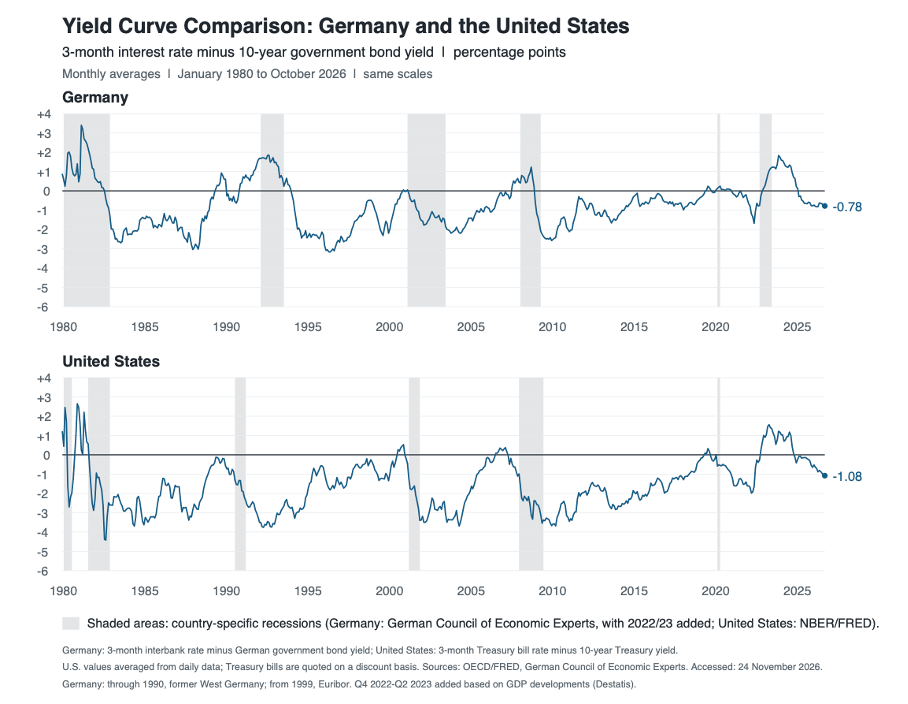
Each of these ten phases was accompanied by an atypical interest rate trend, namely a situation where short-term interest rates were higher than, or at least equal to, long-term rates (unlike usual practice, I have this time plotted the yield curve inversion so that a peak in the curve indicates the maximum restrictive effect). I do not intend to set out the causal relationships in detail here (see Chapter 5 of my introductory textbook), but it is evident that central banks’ attempts to combat inflation using short-term interest rates regularly lead to a situation where recession is on the cards; in other words, sooner or later investment activity slumps and unemployment rises.
The only major exception is the recent development in the US. In 2022, 2023 and 2024, short-term interest rates rose significantly above long-term rates, yet there was no sign of a recession. It is worth taking a closer look at this phase (Figure 2).
Figure 2
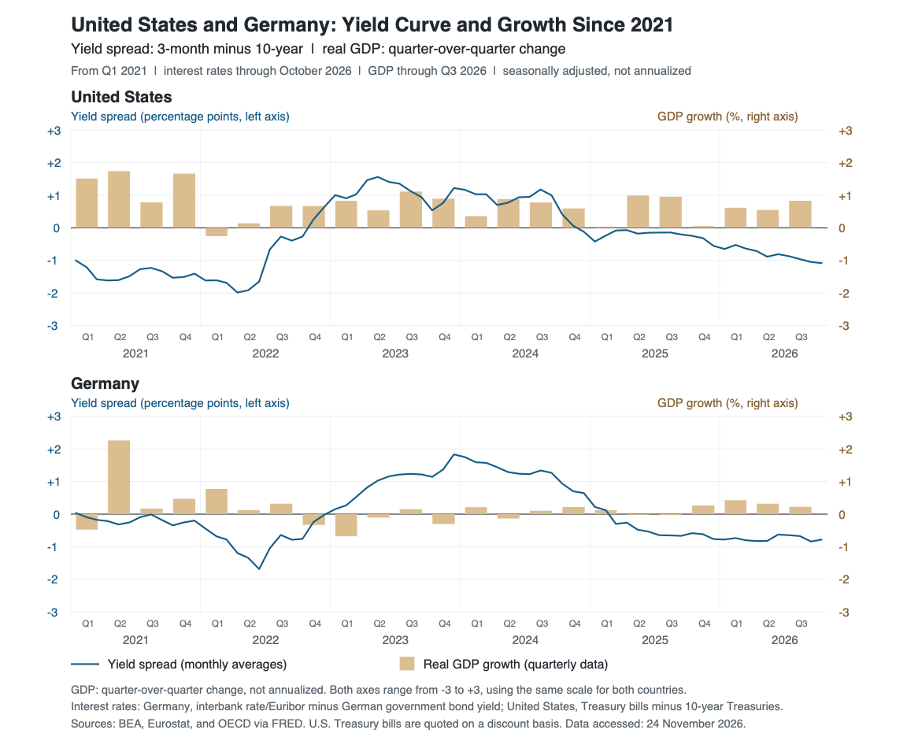
We (my AI and I) have now plotted the growth rates (seasonally adjusted quarterly rates compared with the previous quarter) directly, so that one can see how strong or weak economic performance has been. In the US, despite the yield curve inversion, there was no recession; growth rates in 2024, 2025 and 2026 were mostly close to at least 0.5 per cent per quarter, which are enormously high rates compared with Germany. The only explanation for this in the US must be that the extremely expansionary fiscal policy completely offset the restrictive effects of monetary policy.
However, it would have been completely absurd if an independent central bank had tightened monetary policy in the US in response to this to such an extent that the expansionary fiscal policy could not have taken effect. That would have been the greatest conflict imaginable. In that case, an elected government would have had to insist that it determines policy guidelines, rather than a technocratically run central bank. In the US, however, the situation is – as I have repeatedly pointed out – completely different from that in Europe, because the central bank has direct responsibility for the employment target.
Germany has actually been in recession since the end of 2022. Interest rates are hovering close to zero and, time and again, slightly below it. In this respect, the bar in Figure 1 is far too narrow. It is only since the fourth quarter of 2025 – that is, around a year after the end of the inversion phase – that several consecutive quarters of positive growth have been recorded (provided there are no further revisions to the GDP calculations). There can be no doubt that the ECB’s policy has played a significant part in this development, even if some countries in the eurozone are faring better. The fact that this is not even being discussed in political circles shows the absurdities to which the European-German notion leads – namely, that monetary policy is somehow neutral and that, as an economy or finance minister, one can largely ignore it.
Conclusion
I have said this very often in recent years, but it must be repeated time and again: the ECB’s policy in 2022 was fundamentally flawed. The fatal tendency of the ECB’s leadership to label every price rise as inflation was the root of the problem. Inflation, however, in the sense that most people understand it, is a process that may—but need not—result from a one-off price rise. It is therefore the primary task of monetary policy to ensure that temporary price rises originating from external factors do not lead to inflation.
The first step one would expect from a sensibly managed central bank must be an ideology-free analysis of the situation. The recommendations for action derived from this must be discussed with the key stakeholders, primarily the social partners and governments. Interest rate rises are only warranted once it becomes apparent that attempts to ease the situation through negotiations have not been successful.
Such a rational approach is not made any easier by the fact that a central bank is independent. On the contrary: central banks which, like the ECB, are independent and also have a very one-sided mandate tend to reject any negotiated solution from the outset because they fear for their independence. This is disastrous. If solutions were possible without restrictive policies but fail due to the central bank’s intransigence, one must question its independence; at the very least, the central bank’s mandate must be amended in such a way that it no longer permits one-sidedness and intransigence.