



Christine Lagarde has, for whatever reason, decided not to serve out her full term, but to step down at the start of next year. It is also completely irrelevant whether and when she leaves. She was the most insignificant central bank governor one could imagine. Her insignificance stemmed from her utter cluelessness regarding the origins of and ways to combat inflation.
Yet Lagarde, a lawyer by training, is not alone in this. It is already clear that her successor will be chosen from the ranks of traditional economists, who differ only marginally from a lawyer. This dilemma is not one that can simply be resolved by appointing a new person. In Europe at least (in the US, things are somewhat different), the selection process – which is decisively influenced by Merz and Macron – will under no circumstances produce someone who is truly up to speed with the latest thinking on the theory of inflation.
That is, in fact, the central problem. There is no theory of inflation. In my introductory textbook (which, incidentally, is being published these days in a new edition – the ‘student edition’ – which is considerably cheaper to buy), I devoted a great deal of space to explaining why neoclassical economics fails when it comes to the problem of inflation, and I do not wish to repeat that here. Whilst the US Federal Reserve has a mandate for employment and price stability and simply pursues pragmatic policies, Europe (under pressure from Germany and its economists) has fallen into the monetarist trap.
The ‘monetarist trap’ means clinging stubbornly to the idea that inflation is regularly caused by an ‘excessive amount’ of money. ‘Too much money chasing too few goods’ is what the monetarists around Milton Friedman called it in their simplistic economic theory. The Deutsche Bundesbank adopted this view in a state of great intellectual distress in the early 1970s and, supported by 95 per cent of German economists, has only half-heartedly moved away from it to this day. Half-heartedly, because they do not want to admit just how minimal the influence of monetary policy on inflation really is.
And so it is that the old fairy tales are making a cheerful comeback. Hans-Werner Sinn has just provided the best proof of this in *Wirtschaftswoche* (No. 45, 2026). Sinn has found a lovely metaphor for this. He says that the “ECB’s balance sheet is still overflowing with the vast quantities of government bonds it had … absorbed”. One can easily picture the money supply spilling out of the central bank at every turn and fuelling inflation.
‘Overflowing’ central bank balance sheets
Of course, when a central bank buys government bonds, it issues printed money in return, which, according to the firm belief of monetarists, must sooner or later lead to inflation. However, the matter of ‘overflowing’ is not quite so simple. If one compares the balance sheets of the world’s major central banks, it is readily apparent that the ECB was by no means the biggest ‘overflowing’ bank (Figure 1).
Figure 1
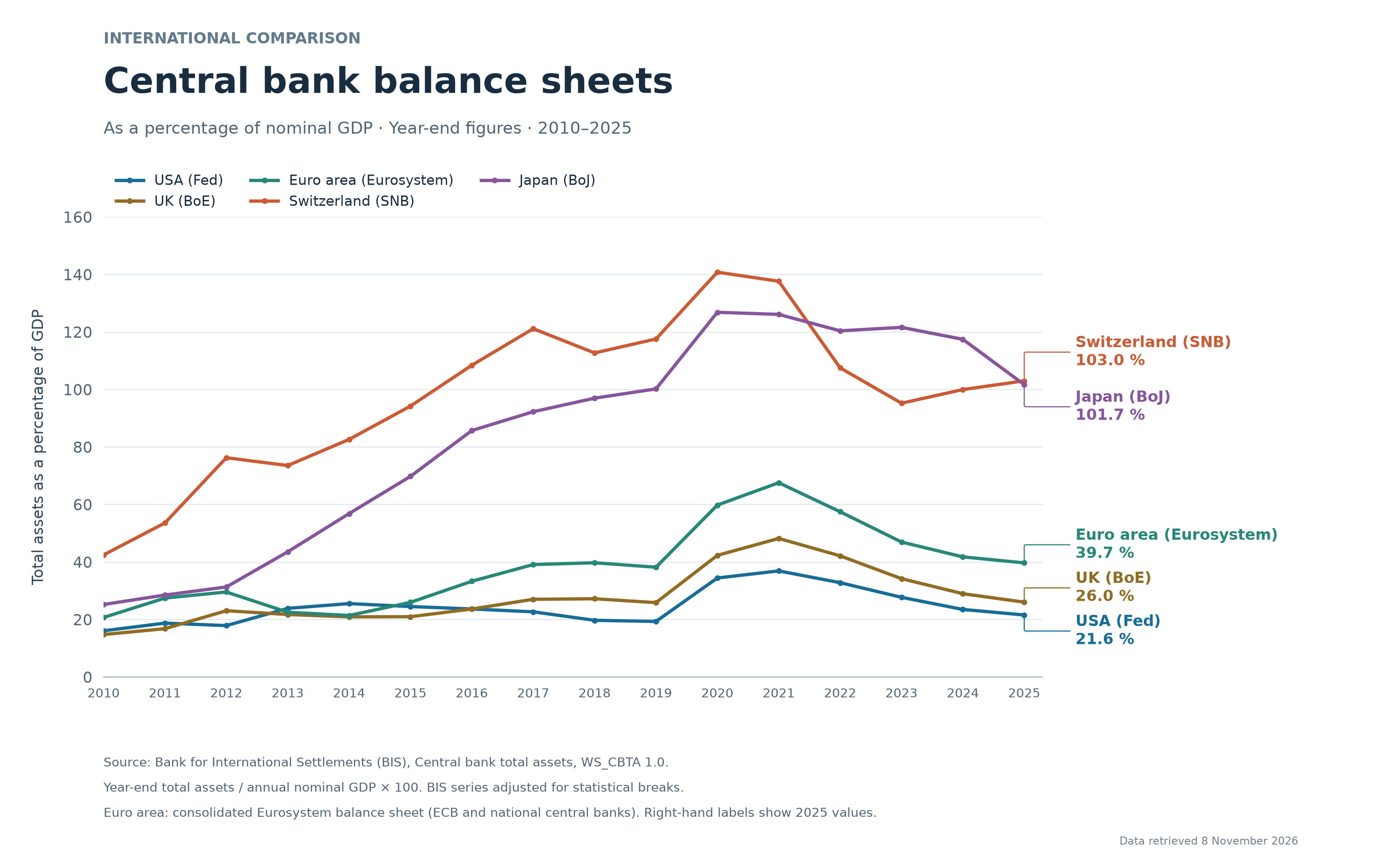
Calculated as a percentage of the respective (nominal) GDP, the Swiss National Bank (SNB) had been far more ‘inflationary’ than any other central bank since the early 2010s. Its ‘overflow’ had already surpassed the highest level ever reached by the ECB (in 2021) as early as 2012, and subsequently rose to 140 per cent of GDP – a level at which ‘overflow’ is no longer an adequate description; this was already a massive overflow, a deluge without parallel. The reason for this was, of course, that the SNB repeatedly had to rein in the financial markets, which, in their speculative frenzy, were on the verge of uncontrollably overvaluing the Swiss franc.
Yet the reason for the expansion of the money supply is irrelevant. Anyone who believes in monetarism believes, after all, in the transmission mechanism that begins with the issuance of money. Why the money is printed is entirely irrelevant. From a monetarist perspective, it is inflationary in any case.
In Japan, too, the central bank’s balance sheet total reached enormous levels of over 120 per cent of GDP. There, the central bank predominantly purchased government securities in order to directly control long-term (and short-term) interest rates. Consequently, the money ended up predominantly with domestic residents, who could easily have used it to purchase goods.
As can be seen immediately from Figure 1, the ECB’s actions were very modest compared to those of Japan and Switzerland. Its ‘expansion’ had already come to an end at just over 60 per cent of GDP. Since then, it has significantly reduced its holdings to 40 per cent. From a monetarist perspective, the reduction in its holdings had a deflationary effect. However, inflation rates actually rose during that very period. The US and the UK also expanded their holdings of government securities to a far lesser extent, even during the Covid-19 crisis.
But where is the inflation?
Of course, according to Hans-Werner Sinn and the entire phalanx of European ‘monetary experts’, the ECB’s high holdings between 2021 and 2024 led to inflation, which – as can easily be seen from current inflation rates – is not yet over.
But here, too, an international comparison is helpful. Figure 2 shows the inflation rates of the five countries under consideration over time and as an average for the years since 2010. Europe, the US and the UK recorded by far the highest inflation rates between 2021 and 2024, yet had by far the lowest balance sheet totals and were in the process of reducing their holdings.
Figure 2

The UK recorded an inflation rate of 9 per cent in 2022 (Switzerland and Japan were hovering around 3 per cent at the time), but its total assets were far below those of the ECB and infinitely lower than those of Switzerland and Japan. The average inflation rate for the entire period is also highest in the UK at 3 per cent, followed by the US at 2.5 per cent.
In Japan and Switzerland, however – the biggest ‘over-expanders’ – inflation rates were clearly the lowest both over the course of the period and on average. Switzerland’s inflation rate remains close to zero per cent even now, although its balance sheet total has recently risen back to over one hundred per cent.
Conclusion
Central banks’ balance sheet totals and money supplies have no influence on inflation. Inflation is never a monetary phenomenon. Because, apart from the monetarists’ primitive transaction equation, there is no attempt in mainstream economic theory to explain and understand inflation, the European Central Bank, too, finds itself repeatedly in a dilemma, both intellectually and because of its one-sided mandate. If it were honest, it would have to explicitly admit that the money supply concepts once adopted from the Bundesbank are unsuitable for monetary policy.
However, as there are no alternatives that would allow the central bank to at least maintain the appearance that it can effectively control inflation, the institution would need economists at its helm who are capable of explaining the complex interplay of factors and the central bank’s dependence on other actors (in particular the social partners) and drawing political conclusions from this. Such people, however, will not exist, because political decisions always favour those who adhere to the tradition of nonsensical orthodoxy.