



Nothing is currently being discussed more than the trend in government bond yields. A look at the figures helps to distinguish scaremongering from reliable information. Nothing is out of the ordinary at the moment apart from the scale of speculation about what the central banks will do next. But that is primarily because the central banks themselves do not know what an appropriate response to the current supply shock is.
The US is particularly in the spotlight with – as even the most uninformed now know – 40 trillion US dollars in government debt. But where is the problem? Figure 1 shows that in the US, the long-term interest rate has diverged slightly from the short-term rate, but not much more than in earlier phases, such as in 2021 and 2022. Long-term interest rates tend to follow short-term rates, but never completely or perfectly. This is entirely to be expected, because the markets (for short-term and long-term maturities) are not separate from one another, whilst the central bank always retains full control over short-term interest rates.
If the belief takes hold in the ‘markets’ that the central bank will raise interest rates sooner or later, investors exit the long-term market, because an interest rate rise means that low-yield government bonds held in their portfolios will lose value. Many market participants try to avoid this by exiting the market for long-term securities early either fully or partially) (although it must always be borne in mind that these securities do not disappear from the market but are bought by someone else; it is simply that market pressure goes towards selling, which causes prices to fall). So, when the possibility of a central bank interest rate rise is on the cards or is hinted at by over-eager members of the central bank’s board, long-term interest rates rise.
Figure 1
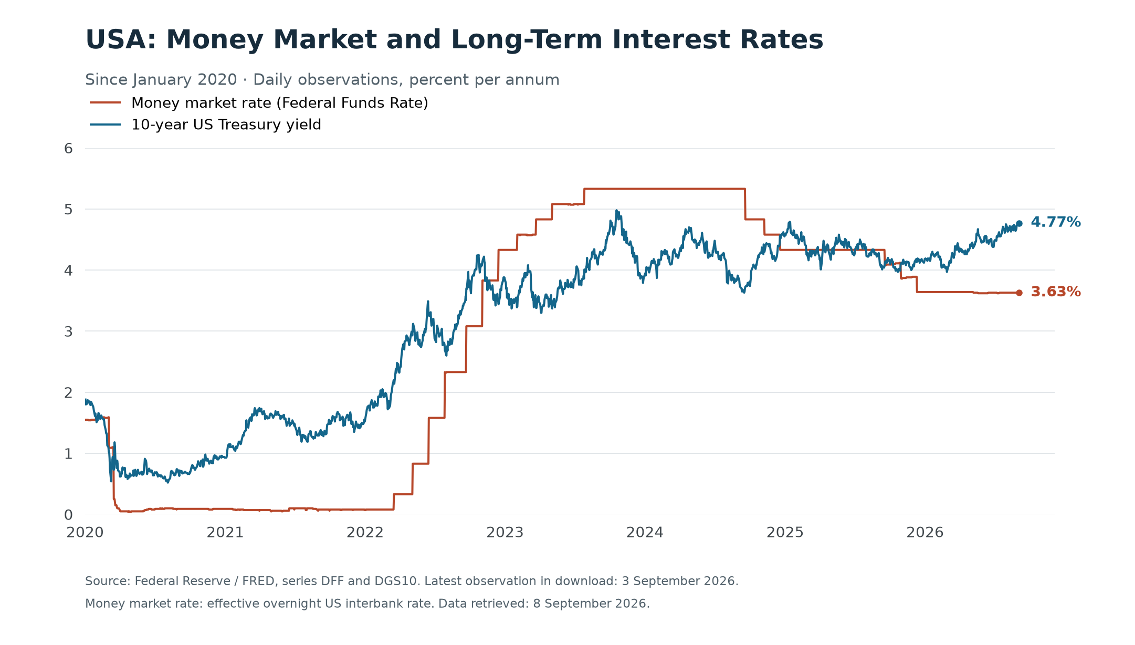
As soon as the central bank actually raises interest rates, the gap between short- and long-term rates narrows again, sooner or later. If it does not, in fact, raise interest rates, a convergence also occurs because the markets buy back the securities they had previously sold off in greater numbers; prices rise and long-term interest rates fall.
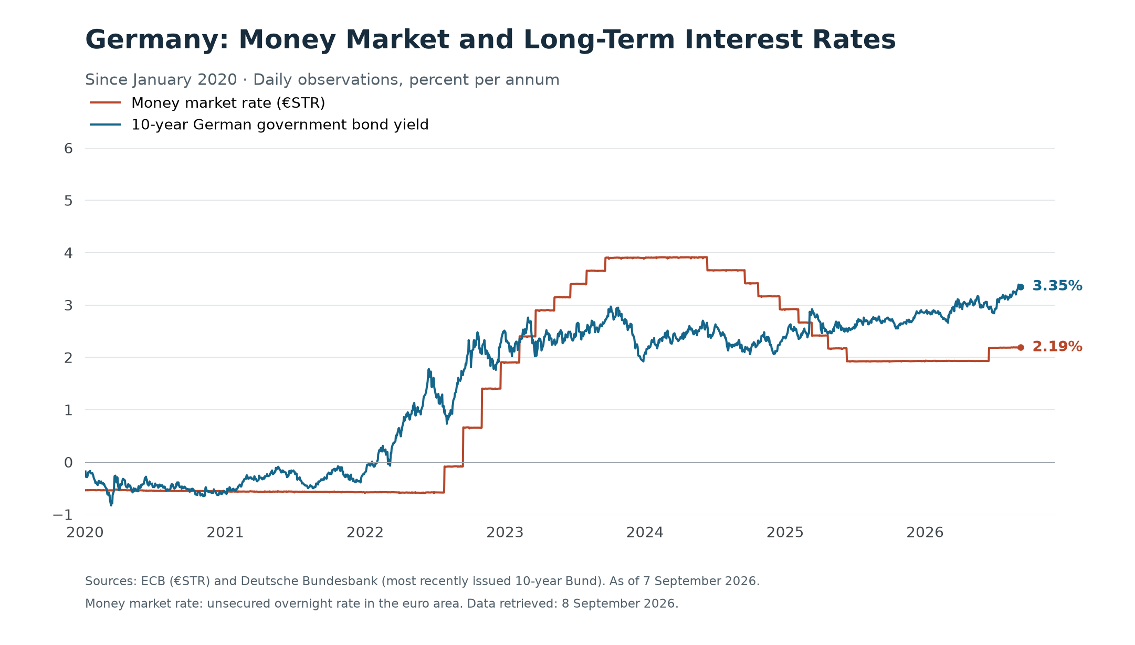
In Germany, the situation is not much different from that in the US (Figure 2), although it is obvious that the US is pursuing a debt policy that is completely at odds with that of Germany. Even at this point, one might ask how it can be that two such fundamentally different countries have a very similar yield curve (a spread of just over one percentage point between short-term and long-term rates). Do the ‘markets’ not realise that Germany is doing everything it can to avoid a debt spiral like the one in the US? Why do the markets fail to reward German prudence at all?
One reason for Germany’s ‘punishment’ – relative to the US – is, however, the ECB’s interest rate rise this year. If the ECB continues this policy this week with a second interest rate rise, the ‘punishment’ will probably become even harsher. It will then become crystal clear that the yield curve is not a market outcome, but is more or less dictated to the markets by the central bank.
Figure 2
The situation in France must be assessed somewhat differently (Figure 3). In France, the long-term interest rate is significantly higher than the German rate, even though both are members of the same monetary union and therefore have exactly the same monetary policy conditions. The long-term interest rate is exactly two points above the short-term rate.
Figure 3
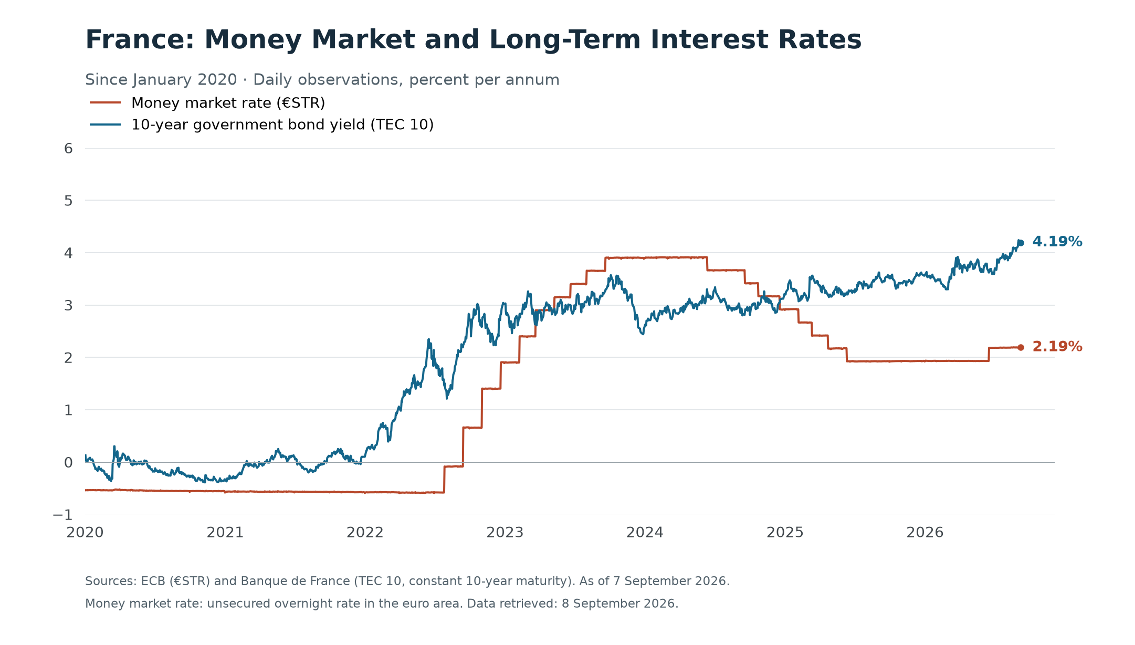
There is a reason for this. The ‘markets’ are more inclined to short French bonds than German ones, because the EMU has already demonstrated what it should never have shown – namely, that individual countries within the eurozone can become insolvent. This is the ‘Greece syndrome’. France is currently suffering as a result of the absurd policy towards Greece between 2011 and 2015, which made it abundantly clear to even the most uninformed that the European Monetary Union was devised by utterly incompetent economists and is being implemented by amateur economic policymakers.
Now would be a good opportunity to dispel this notion from the markets once and for all, by the central bank demonstrating that it will not tolerate differing long-term interest rates within the EMU. But where is the common sense to be found, all of a sudden, that would be needed to override the markets’ ridiculous speculation?
Nor is there any justification for the frequently voiced view that the markets simply ‘demand’ higher interest rates. Market participants generally have no right to make demands; rather, they must adapt to market conditions. If they have no alternatives to government bonds – which is obvious to the world at large – they can kick up a bit of a fuss, but they have no real influence. Just like short-term interest rates, the yield curve is ultimately a creation of the central bank, which can rigorously override the markets at any time. And it must do so time and again, because the ‘financial markets’, as I have shown in detail in my introductory book, are simply incapable of achieving sensible results when it comes to price formation.
The charts were generated using AI.