



Today saw yet another interesting and extremely important statistic that has gone unnoticed by both the media and so-called economic science. As it does every month, Eurostat published the trend in producer prices for the manufacturing sector. The latest available figure is for February, i.e. the figure not yet influenced by the US-Israeli war of aggression, which contravenes international law.
If one examines the trend in these prices excluding energy prices (there is a chart on this under the link above), the enormous stability in this sector – which I have often highlighted – becomes apparent. Since the start of 2023, prices across the entire eurozone have remained at the level recorded at that time, with an index standing at 120 (the base year is 2021=100). This shows that competition in industrial products is so fierce that, on balance, companies have not managed to raise prices over the past three years, even though costs – particularly labour costs – have risen year on year.
Looking now at the respective national levels (table), there is a high degree of uniformity, which also demonstrates just how fierce the competition is. With few exceptions, almost all countries remained very close to an index level of 120 in February of this year. This is a remarkable convergence, showing that the larger countries in particular have little scope for upward deviation. Italy and France, however, have managed to keep their price levels slightly below Germany’s, presumably because they have pursued a consistent policy of wage restraint.
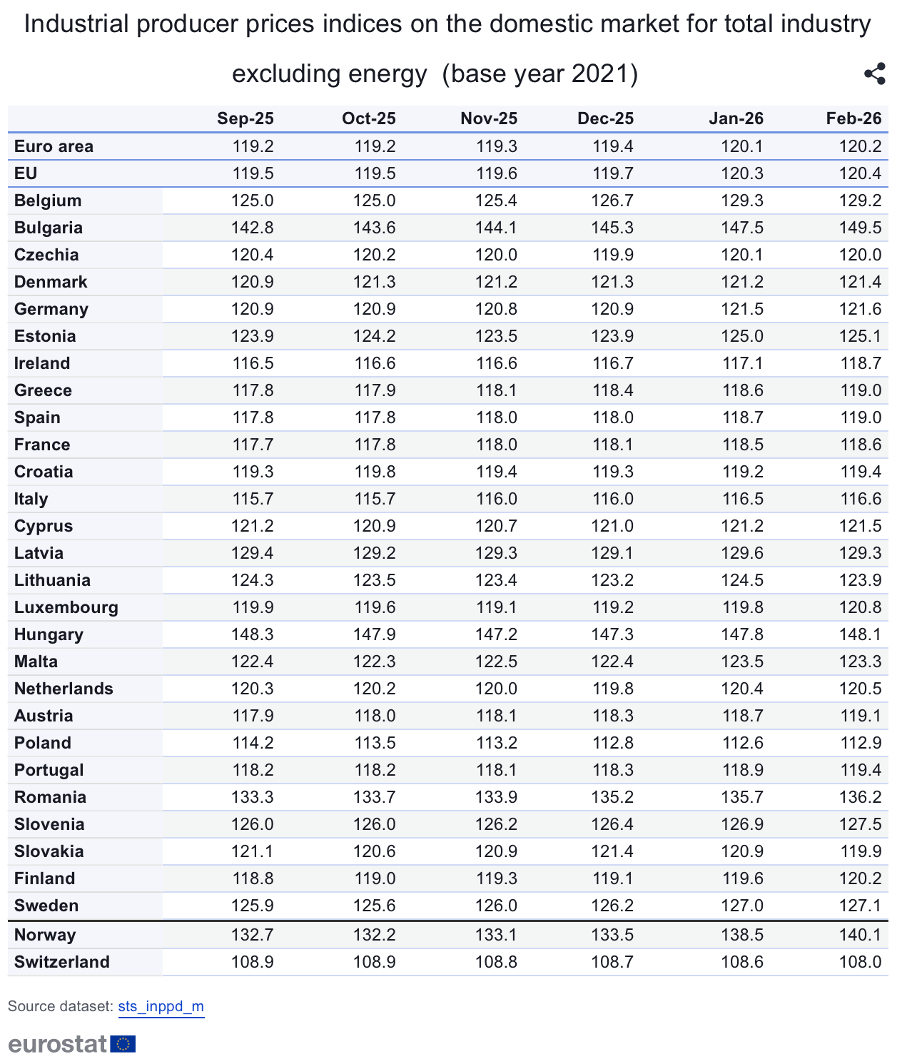
Within the EMU – that is, amongst the countries that can no longer use currency devaluation to offset excessively high price levels – Belgium (129), Bulgaria (149), Estonia (125), Latvia (125), Lithuania (123) and Slovenia (127) stand out in particular. In Belgium, the relatively high level may be linked to the fact that very high wage increases were implemented there following the COVID-19 crisis, which are still reflected in prices today, even though wage pressure has since eased significantly. In the Eastern European countries, as shown here, the influence of wages is clearly responsible for the price divergence.
Bulgaria, the poorest and at the same time youngest member of the EMU, is pursuing a radical course of wage adjustment, from which local companies cannot escape. An upward price deviation of around 30 per cent within a few years means that even for Western companies producing in Bulgaria, which still operate at a very low initial price level, they will soon lose the competitive edge they had calculated for their production in Bulgaria. For indigenous Bulgarian firms with low productivity, there is no chance of survival in this scenario.
These figures show unequivocally that very rapid wage convergence, which is not matched by productivity gains, places manufacturing firms in great distress when competitive pressure is as intense as it currently is within the EMU.
Either the companies (primarily Western direct investments) raise their prices, even if this severely limits their long-term viability, or they bow to price pressure and do not pass on even relatively high wage increases in their prices (Croatia is the prime example here). This, too, shortens the period during which they can make the profits expected in the country.
The consequences are dramatic when Western companies cease production after just a few years because the windfall profits have dried up. There are then no longer any domestic companies capable of taking their place. These countries will consequently face enormous structural difficulties for many decades to come, because without a domestic industry, there can be no catching up in terms of productivity and living standards. The exodus, which, as shown in this Atlas of the World Economy, has already reached massive proportions in Bulgaria, will increase once again.